Wednesday, May 30, 2018

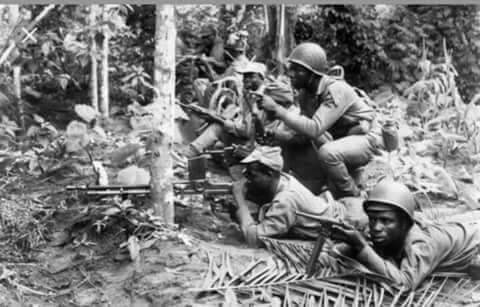
In Memory Of The Over 4 Million Innocent Biafran Men, Women, And Children Massacred


By Okoro Ukata

The preservation of everything historic, pertaining to the Igbo people of Biafra land is an important part of the Igbology project. Our culture, tradition, and custom cannot be complete without our story. The gory story about our past. And this is understandable when we remember that what's involved is the over 4 million lives of Biafrans lost in an avoidable war on a peaceable people whose custom and tradition hold human lives sacred. Whose customs and norms place a high value on human lives. An accommodating and hospitable people who were never known or seen as war-like, even till date. 

Every 30th of May is set aside to remember this bit of ugly history, to keep their memory burning and to honor their sacrifice for the entire Biafran nation made up of a diverse people, united with one common blood.


In Memory Of The Over 4 Million Innocent Biafran Men, Women, And Children Massacred

In Memory Of The Over 4 Million Innocent Biafran Men, Women, And Children Massacred


In Memory Of The Over 4 Million Innocent Biafran Men, Women, And Children Massacred


In Memory Of The Over 4 Million Innocent Biafran Men, Women, And Children Massacred


In Memory Of The Over 4 Million Innocent Biafran Men, Women, And Children Massacred 


Monday, April 2, 2018

Igbos: Preserving Culture And Tradition Through Dances


Atilogwu
Igbo Dances Photo Credit: Face2FaceAfrica.com

By Okoro Ukata

Gymnastics which is a coveted Sport in the Western had been a part of Igbo traditional dances before colonial days. One of the characteristics of Igbo dances is that a lot of body movements are involved. In fact, all parts of the human body are involved in Igbo traditional dances. Another peculiarity with Igbo dances is that each part of Igbo land has a unique or characteristic dancing and beating styles by which the people are known. Example is the Mkponkiti or Atilogwu dance of Enugu and Anambra people, Bongo music of the Owerri people, Abigbo dance of Mbaise people, Ikpirikpe or War dance of Ohafia, Abam people etc. In all, Igbo dances and songs are all enjoyable no matter from which part of Igbo land such a song is played. Remember, one of the uses of traditional dances and songs is that it is one of the means Igbos preserve their culture and tradition, apart from entertainment. Sit back and enjoy a typical video dance of the Igbo people of modern times below:     


Tuesday, March 27, 2018

Uli Airport: Africa's Busiest Airport In 1968


Uli Airport was the busiest airport in Africa in 1968. It was built by Biafra engineers. This picture was taken in 1971 - a year after the Civil War.

Saturday, September 2, 2017

Bruce Mayrock: The American Jew Who Died To Give Freedom To Afronoid Jews

Image result for bruce mayrock


By Okoro Ukata 

Silence is a menace. Why? Because silence itself has plunged this world into untold despair and wreckage. Silence has caused a lot of anguish to millions of people in this world. 

Oppressors prey on their victims and dominate them as a result of the silence of those who were supposed to speak up.

It is because of such silence that made Bruce Mayrock, a 20-year-old Jewish man to immolate himself in the front of UN Building. On 30th of May 1969, Bruce went in the front of UN Building, on the outside lawn and set himself on fire to protest the world's silence, while the Islamic northern government of Nigeria was committing a genocide and the extermination of millions of the Biafran people. 

America and Britain had aided the Nigerian government to impose a blockade which had cut off necessary food and supplies vital for the survival of the people as such over 4 million innocent Biafran women and children were wiped off by hunger and starvation. This infuriated Bruce Mayrock.

Image result for bruce mayrockPhoto credit: Oblong media

Bruce Mayrock had studied briefly at Hofstra University and enrolled briefly, as well in September 1967, at a Jewish Theological Seminary. At the time of his death, Mayrock was a student in the School of General Studies, Columbia Universiy, New York, and was working as a sports photographer for the publication, Columbia Daily Spectator. 

Shortly before 3 p.m on Thursday, Bruce Mayrock doused himself with a flammable liquid according to Columbia Daily Spectator and went to the lawn outside the U.N. Building to set himself on fire. He was chased by two UN guards with fire extinguishers to put out the flames, which was happening in the front of hundreds of horrified delegates and onlookers. 

Mayrock, ran and escaped the guards fully ignited and went and fell down beneath the statue at the UN Building, bearing the Biblical inscription about beating the swords into plowshares and learning war no more, which was found in the book of Isaiah. There at the spot, the guards caught up with him and put out the flames; and he was rushed to Bellevue Hospital, New York, in a critical condition. Sadly, he died after midnight on Friday. 

In the front of the lawn was found Bruce Mayrock's cardboard sign inscription he had been protesting with which had read, 

"You must stop the genocide - please save 9 million Biafrans."

The publication he worked for at the University, also reported that Bruce Mayrock had protested actively writing letters to leading government figures and to the president of the United States of America, to stop the war. 

Image result for bruce mayrock

And a rabbi close to Bruce's family quoted the young Mayrock as, "an idealistic young man deeply upset by the events in Biafra...People were being killed and he felt no one was doing anything. That was why he did what he did," according to the University publication's report. 

But it was not a mere coincidence of nature that Bruce Mayrock had chosen to die for a people he had not even seen or a people who were inhabiting in a faraway place he had never visited before. 

Today's Biafrans had always recognized the genetic and bloodily relationship they share with Bruce Mayrock. 

Biafrans not only do they regard themselves as Jews, but had strong cultural and historical evidence to prove their Jewish lineage. 

Right at the heart of Igbo land, among the people of Biafra, stands today, an ancient palace, temple, and altar built in honor of Gad, one of the twelve sons of Jacobs whose name was mentioned in Numbers 32:33 of the Old Testament of the Bible or the Jewish Torah. 

This house of Gad is called "ObuGad". And it still stands till date in Aguleri.  There at present day Aguleri, the direct descendants of Eri, one of the sons of Gad, can still be traced in Anambra State.     

It is remarkable that this House of Gad had been built even before the white men coming in contact with Africans. As such, it had always been as ancient as the settling of the Igbo Jews on Biafra land.

Image result for obu gadInside of the ancient "House of Gad" or "Obu-Gad" built by the descendants of Eri in honor of their father Gad. Photo credit: www.hebrewigbo.com


This is why the Biafrans believed that Bruce Mayrock sacrificed his life for his own brothers and sisters; and as such, he would never be forgotten forever and ever by the people of Biafra whom he had paid the ultimate price, to help secure their freedom. 


Image result for obu gadThis is the OBU-GAD, or The House of Gad in Aguleri. An ancient house built in honor of Gad at the heart of Igbo land, Aguleri in Anambra State. 
Photo credit: Igbo Gad Archeology, YouTube 


Image result for obu gad
Photo credit: edonationsatelite.blogspot.com


Opening image credit: African Free Press

Saturday, August 19, 2017

Do You Know Steve Jobs, Co-founder Of Apple Inc. Left The Church Because Of The British Role In The Biafran War?

Image result for biafran starving children
By Okoro Ukata

Steve Jobs was the American inventor/entrepreneur and co-founder and ex-CEO of Apple Inc., makers of iPhone, iPod, iPad, and the Apple Computers; who was born and bred in San Francisco, U.S.A. Though the world lost him in death in October 2011, his products and businesses remain one of the most popular brands globally.

At a time, when an international magazine published the photos of famishing and dying children on their cover photo, Steve Jobs was rattled that Britain, a so called Christian country was behind the carnage and holocaust, overseeing the starving to death of over 4 million innocent women and children in Biafra land, a people who were 99% Christians, as well. 

It was in history that for over 3 years, the war lasted, British government and Army were the ones who planned and directed the Nigerian soldiers on the war fronts executing the extermination. Besides, their supply of Ferret armored cars, Saladin armored scout cars, Fox armored scout cars and other lethal weapons to the Nigerian government to wage the war against the Biafrans; a war that lasted from 1967-1970.

According to Washington State University website in an article written by COLE KIRKPATRICK, the Biafran war led by Colonel Ojukwu engaged the war to escape the "Dictatorship of the Northern Nigeria Military who were immensely discriminating the people of Southern and Eastern Nigeria."

This war, the University website blamed on the British as those who caused it as a result of how "Britain left the country at an uneasy state after Nigeria declared its independence in the beginning of 1960."

Steve Jobs could not understand how Britain a so called Christian nation could collaborate with the Government of Nigeria controlled by the Muslim North, against the Biafrans who are predominantly a Christian land. He imagined that as the colonizers of the people, they would have made peace for them, rather than side the Islamic federal government to exterminate another group of same faith.

Truly, this war that snuffed away over 4 million Biafran lives mostly women and children as a result of artificial famine created by the British's sponsored land and sea blockade preventing food and supplies entering the Biafran zone, and leading millions to waste away in extreme hunger and malnutrition. Thus the University website was right to call the war, "One of the most deadly inter country wars that took place in the twentieth century."


Image result for biafran starving children
Starved Biafran children. Photo credit: Nairaland 

Opening image: Biafran children. Photo credit: Subversify Magazine

Saturday, August 12, 2017

The American Who Died For Biafra


By Okoro Ukata

August Martin:

He was the first African American to pilot a commercial aircraft. His middle name was Harvey, born in Los Angeles, California. Her mother, a professional teacher taught her at home until he was 13. After which he went to Secondary School and also graduated from the University.
August Martin washed airplanes at the Oakland Flying Service to earn money that enabled him to train on how to fly.

He completed his training at the University of California, civilian pilot training program. He later joined the U.S. Army around 1943 and perfected in the flying of the B-25 twin-engine bomber and various other ranges of advanced fighter jets. 

He later left the army and went back to commercial piloting where he flew for Buffalo Skylines, El Al Airlines, and World Airways. He was the first black captain of an LI.S. at Seaboard World Airlines.

August Martin was convinced that the war being waged against Biafrans was unjust and took it upon himself to use his airplane on a Mercy Mission to come drop food for the millions of starving Biafran women and children dying because of the British sponsored air and sea blockade against the Biafrans. 

Despite all threats from the Nigerian government, August Martin continued to single-handedly fly food and other supplies to the Biafrans. 

But unfortunately, in 1968 he was killed while trying to land his aircraft in a rainstorm at Uli, though some account had it that his aircraft was shot down and crashed by the Nigerian troops. He died June 30, 1968, and all Biafrans remember August Harvey Martin this day, as one of the heroes of the Biafran people.

Today, a school in New York still bears his name in honor of this great African-American whose legacy can never be forgotten by the people he died helping: The massacred people of Biafra. 

He was born August 31, 1919.


Opening image: August Harvey Martin. Photo credit: Geni

Wednesday, May 31, 2017

Biafra At 50: The Need To Avert Another Genocide And Give Way To A UN-Backed Referendum


A major busy highway looking deserted as a result of the observance of the Sit-at-Home Order of IPOB to mark Biafra @50. Photo credit: Naira Land

Yesterday, May 30th was marked as Biafra's Heroes and Heroines day. This year's celebration was a double-barreled celebration, which at one hand is commemorating Biafra at 50 and in the other, marking a Memorial about the over 3 million innocent men, women and children that lost their lives in various ways as a result of the war. As one source had put it, those who died from deprivation and extreme hunger due to British sponsored land, air and sea blockade in Biafraland, far out-numbered those killed from the barrels of the gun. 

This year's remembrance was special in at least two ways: There was no record of any single casualty; as it was as marked peaceful as a dove. Secondly, it recorded a huge success. 

To mark the celebration, Nnamdi Kanu who is regarded today as the New Face of the Pro-Biafran Movement, made a call for all Biafrans to sit at home and avoid the streets, in order to checkmate the usual brute following the Nigerian Police and Army use of maximum force to quell their peaceful protests. 

There was total compliance to the Order as was reported from several sources, including BBC.

Below is the result of the Sit-at-Home report according to a post circulating in the social media:

The Indigenous People of Biafra Sit at Home Order and Scores of each State:
Anambra (Exceptional) 100%
Abia (Exceptional) 100%
Rivers (Unrivalled) 100%
Bayelsa (Excellent) 100%
Cross River (Excellent) 100%
Akwa Ibom (Overwhelming) 100%
Imo (Intimidatingly) 100%
Enugu (Very good)100%
Ebonyi (Very good) 100%
Delta (Exceptional) 100%
Igbanke/Edo (Very good) 100%
Igala/Kogi/Benue Very good) 100%
Idoma/Benue  (Excellent) 100%
Igede/Benue (Very good) 100%
Agatu/Benue (Benue (Very good) 100%

The Biafra Sit At Home 2017 is a resounding success. This was made divinely possible by God of Israel and Biafra. Is there any Referendum more than this?The answer is no. 

The international observers and foreign journalists that gave coverage expressed satisfaction and poured encomiums on the Biafran nation.

Referendum not contained in the Nigeria criminal Constitution of 1999 as handed down by....in khaki is now Nigeria's headache, not that of Biafra again. 

The Indigenous people of Biafra have eloquently spoken, saying bye to Nigeria. A good riddance to a bad rubbish.

Long live Biafra, long live Nnamdi Kanu. Long live lovers of freedom all over the world. All hail Biafra.
Biafrans in Italy and all over the world, also joined in marking the 50th anniversary of Biafraland.

Monday, May 29, 2017

Were There Advantages Of Traditional Wrestling Of The Igbo People Or Was It Just An Observance Of A Mere Culture?


Image result for traditional wrestling in Igboland

By Okechukwu OKugo

From ancient times, sporting has been a part of the culture of people all over the world. Examples are the Olympic observance of the ancient Greeks and the gladiatorial fights of the Romans etc. Thus, the Igbo people of West Africa were not left behind in these types of sporting cultural observance.

There were certain things that would culturally bestow honor on both men and women in Igbo societies, and one of such things, which though in this case, was exclusively reserved for the menfolk was traditional wrestling. Male folks of different age brackets engage in it. It can be a leisure activity or a big communal event.

Unlike the western style of wrestling or other sporting activities, which had involved a lot of blood and gore, with extreme violence that had in many cases led to people losing their lives participating, Igbo traditional wrestling does not involve any violence. It basically seeks to search out among two people, the one with more strength, courage, resilience, and physical power, who will succeed to make his opponent's back touch the soil of Igboland. 

Understandably, the corresponding struggles and the grapple to hold the other's body parts, to find a leverage that will enable the other lift his opponent high in the air, before cheering spectators who would usually gather at the village square to witness the contest. 

Traditional wrestling is a culture of the Igbos and many other African ethnic nationalities. Contests can be organized between two different villages in which each one presents their champions to represent their entire community.
Much communal prestige is bestowed on the contestants such that it is regarded that the one who had won in the contest had brought honor to the entire village. And this explains why the champions of various villages were regarded with honor and respected among the male folks and admired among all the village maidens. 

Most times, in the olden days, families from whom the champion would be seeking the hand of their daughters in marriage were regarded as privileged families; and in most cases, the most beautiful belles were reserved for them.

One of the numerous advantages of this tradition was that, in certain cases, it had served as a protection for the entire community. This is because, villages in which it's known that there are many gallant and valiant men who perform well in these traditional wrestling contests, were very famous, and regarded as strong and courageous people. 
As such, their neighbors would not want to go up to them in communal skirmishes or warfare. In cases, when certain disputes like land tussles, arose among the people and their neighbors, they would seek to resolve their matters through dialogue than facing them in tribal battles.

K'anyi waa Oji

Oji

K'anyi waa Oji

Source: Aka Ikenga

Ibe-anyi Oji abianu - by Kevin Ndubuisi Anaruagu

Egbe belu Ugo belu.......
Nnekwu okpa ga adi,
Obele okpa ga adi,
Udo adiro na uwa taa, mana nke fodulu nu ka ga ezulu onye obula. Chukwu ga
emezuru anyi nine nkpa anyi di n'iche n'iche.
Ana m ayo Chukwu ka O gozie Oji a m' ji n'aka gozikwa nke gi bu onye na agu
edemede a ji n'aka ka ozua anyi aru na mkpurobi, n'ihi JESU CHRISTI onye nwe
anyi.

Sunday, May 28, 2017

Igbo Culture In Photos

Image result for igbo culture
Cultural Dance.   Nairaland Forum


Image result for igbo culture
Cultural Dance. Alliance of Nigerian Organizations in Georgia, USA


Image result for igbo culture
Igbo Traditional Wrestling. Observe Nigeria


Image result for igbo culture
Igbo Traditional Wedding. Nairaland Forum


Image result for igbo cultureNew Yam Festival. Pulse.ng


Image result for igbo culture
Igbo Traditional Flutist. ICSN


Image result for chieftaincy coronation in Igboland
Chieftaincy Coronation. Tori News


Image result for chieftaincy coronation in Igboland
Conferring Chieftaincy Title on Timipri Sylva, Ex-Governor In Nigeria. OnlineNigeria News


Image result for chieftaincy coronation in Igboland
Palmwine Tapper. Igbo Culture and Tradition


Image result for king makers in IgbolandBlessing of Kola Nut. LiteracyBase


Image result for burial ceremony in IgbolandBurial Ceremony In Igboland. Ask Naij.com


Related image


Titled Igbo woman with Ichi marks.  Pinterest


Nsibiri: The Pre-colonial Writing Of The South Eastern People


  • Image result for igbo symbols


by Crayola1
Source: NairaLand

The logograph for Nsibiri

Nsibidi (also known as nsibiri,[2] nchibiddi or nchibiddy[3]) is a system of symbols indigenous to what is now southeastern Nigeria that is apparently ideographic, though there have been suggestions that it includes logographic elements.[4] The symbols are at least several centuries old: Early forms appeared on excavated pottery as well as what are most likely ceramic stools and headrests from the Calabar region, dating between 400 and 1400 CE.[5] Nsibidi's origin is generally attributed to the Ekoi people of southern Nigeria. Alternatively J. K. Macgregor claimed in 1909 that it is traditionally said to have come from the Uguakima, Ebe or Uyanga tribes of the Igbo people, which legend says were taught the script by baboons,[3] although one writer believes Macgregor had been misled by his informants.[6]

There are thousands of nsibidi symbols, of which over 500 have been recorded. They were once taught in a school to children. Many of the signs deal with love affairs; those that deal with warfare and the sacred are kept secret.[7] Nsibidi is used on wall designs, calabashes, metals (such as bronze), leaves, swords, and tattoos.[2][8] It is primarily used by the Ekpe leopard secret society (also known as Ngbe or Egbo), which is found across Cross River among the Ekoi, Efik, Igbo people, and related peoples.

Outside knowledge of nsibidi came in 1904 when T.D. Maxwell noticed the symbols.[4] Before the British colonisation of the area, nsibidi was divided into a sacred version and a public, more decorative version which could be used by women.[8] Aspects of colonisation such as Western education and Christian doctrine drastically reduced the number of nsibidi-literate people, leaving the secret society members as some of the last literate in the symbols.[9] Nsibidi was and is still a means of transmitting Ekpe symbolism. Nsibidi was transported to Cuba and Haiti via the Atlantic slave trade, where it developed into the anaforuana and veve symbols.[10][11]

The origin of the word nsibidi is not known. One theory traces the word to the Ekoid languages, where it means "cruel letters", reflecting the harsh laws of the secret societies that hold nsibidi knowledge.[12][13] In Calabar, nsibidi is mostly associated with men's leopard societies such as Ekpe. The leopard societies were a legislative, judicial, and executive power before colonisation, especially among the Efik who exerted much influence over the Cross River.[5]

Origin

The origin of nsibidi is most commonly attributed to the Ejagham people of the northern Cross River region, mostly because colonial administrators found the largest and most diverse nsibidi among them. Nsibidi spread throughout the region over time and mixed with other cultures and art forms such as the Igbo uli graphic design.[5]

Status

Nsibidi has a wide vocabulary of signs usually imprinted on calabashes, brass ware, textiles, wood sculptures, masquerade costumes, buildings and on human skin. Nsibidi has been described as a "fluid system" of communication consisting of hundreds of abstract and pictographic signs. Nsibidi was described in the colonial era by P.A. Talbot as a "a kind of primitive secret writing", Talbot explained that nsibidi was used for messages "cut or painted on split palm stems". J.K. Macgregor's view was that "The use of nsibidi is that of ordinary writing. I have in my possession a copy of the record of a court case from a town of Enion [Enyong] taken down in it, and every detail ... is most graphically described". Nsibidi crossed ethnic lines and was a uniting factor among ethnic groups in the Cross River region.[5]

Uses

Court Cases - "Ikpe"


The Ikpe from Enyong written in nsibidi as recorded by J. K. Macgregor

Nsibidi was used in judgement cases known as 'Ikpe' in some Cross River communities. Macgregor was able to retrieve and translate an nsibidi record from Enyong of an ikpe judgement.


The record is of an Ikpe or judgement case. (a) The court was held under a tree as is the custom, (b) the parties in the case, (c) the chief who judged it, (d) his staff (these are enclosed in a circle), (e) is a man whispering into the ear of another just outside the circle of those concerned, (f) denotes all the members of the party who won the case. Two of them (g) are embracing, (h) is a man who holds a cloth between his finger and thumbs as a sign of contempt. He does not care for the words spoken. The lines round and twisting mean that the case was a difficult one which the people of the town could not judge for themselves. So they sent to the surrounding towns to call the wise men from them and the case was tried bv then (j) and decided; (k) denotes that the case was one of adultery or No. 20.[14]

Ukara Ekpe

[b]The Igbo 'Ukara' cloth of the Ekpe society, covered in nsibidi
Nsibidi is used to design the 'ukara ekpe' woven material which is usually dyed blue (but also green and red) and is covered in nsibidi symbols and motifs. Ukara ekpe cloths are woven in Abakaliki, and then they are designed by male nsibidi artists in the Igbo-speaking towns of Abiriba, Arochukwu and Ohafia to be worn by members of the Ekpe society. [/b]Symbols including lovers, metal rods, trees, feathers, hands in friendship war and work, masks, moons, and stars are dyed onto ukara cloths. The cloth is dyed by post-menopausal women in secret, and young males in public. Ukara was a symbol of wealth and power only handled by titled men and post-menopausal women.[15]


The Igbo 'Ukara' cloth of the Ekpe society, covered in nsibidi

Ukara can be worn as a wrapper (a piece of clothing) on formal occasions, and larger version are hung in society meeting houses and on formal occasions. Ukara motifs are designed in white and are placed on grids set against an indigo background. Some of the designs include abstract symbols representing the Ekpe society such as repeating triangles representing the leopard's claws and therefore Ekpe's power. Ukara includes naturalistic designs representing objects such as gongs, feathers and manilla currency, a symbol of wealth. Powerful animals are included, specifically the leopard and crocodile.[5]


The name of a boy called 'Onuaha' as recorded by J. K. Macgregor in 1909. Macgregor interpreted the first two symbols as corruptions of the English letters 'N' and 'A' and the last symbol a generic nsibidi. Macgregor noted the growing European influence on nsibidi.

Examples of Nsibidi

Here are some examples of nsibidi recorded by J. K. Macgregor (1909)[14] and Elphinstone Dayrell (1910 and 1911)[1][16] for The Journal of the Royal Anthropological Institute of Great Britain and Ireland and Man. Both of them recorded symbols from a variety of locations around the Cross River, and especially the Ikom district in what is now Cross River State. Both of the writers used informants to retrieve nsibidi that were regarded as secret and visited several Cross River communities.

"Nsibidi"

"Welcome"

"Two men talking"

"Door"

"Gun"

"Crossbow"

"Calabash"

"Big drum"

"Etak Ntaña Nsibidi — Nsibidi's bunch of plantains. When the head of the house wants plantains he sends this sign to the head boy on the farm."[16]

"Umbrella"

"Toilet soap"

"Matchet"

"Woman"

"Man"

"Moon"

"Tortoise"[1][14][16]
Re: Nsibiri: The Pre-colonial Writing Of The South Eastern People by Crayola14:10pm On Jun 252012
More Examples smiley


1 Like 1 Share
Re: Nsibiri: The Pre-colonial Writing Of The South Eastern People by Crayola14:20pm On Jun 252012
There have been various attempts to revive the writing for daily use, one such site with this goal is http://nsibiri.blogspot.com

The site author's mission statement:

Mission

Objective

The mission of the Nsibiri Project (the name 'nsibiri' chosen for no particular reason apart from the fact that nsibidi was an already occupied blogspot/domain name) is to record, modernise, and make the nsibidi ideographic symbols relevant for communication in the Igbo language and Cross River languages such as Efik, Kwa and Ejagham, by transitioning it into a (fully) logographic script. Nsibidi is also meant to inspire and encourage Igbo descendants, and people in general, to learn the languages it will be used in, and to attempt to add the Igbo and other related cultures to the worlds general consciousness, in a positive light, overtly!

Why not just the current önwu script?

I don't know about you, but I know quite a few fluent Igbo speakers that have trouble reading a sentence in the önwu (very ironic name) Latin-derived alphabet. If you give an average Igbo speaker a novel in Igbo, even with all the accents, they will not be able to read it as fluently as an English speaker reading an English book. The problem, for Latin, is that Igbo is a tonal language and it has limited grapheme's (symbols) to represent the many different tones, phonemes (sounds) and syllables that Igbo utilises. Latin was never made for Igbo, it was there for the convenience of those who wanted to tell Igbo speakers that they have a new queen. Using Latin in Igbo is like using a nice silver Italian (wait for it...) designer fork to eat some extra spicy, thick, meaty, and flavourful pepper soup made with aged ingredients (sorry...).

Do you ever wonder why most African cultures never independently developed a writing system above the level of ideographs? 

(nothing really wrong with that) I believe this has something to do with many of the languages being tonal. I believe a Chinese speaker fluent in the Latin alphabet will not be able read any of the Chinese languages in Latin, I found a perfect example of why this is on Wikipedia:

妈妈骂马的麻吗?/媽媽罵馬的麻嗎?
Pinyin: māma mà mǎ de má ma?
English: "Is Mother scolding the horse's hemp?"
http://en.wikipedia.org/wiki/Tone_%28linguistics%29

Chinese, and some other tonal languages are read by billions of people with logographic writing systems. To a certain extent, Igbo/Ibibio was using some logographic symbols. Logographic symbols do not require you to pronounce a word, but, rather, to understand the word which is important in languages with lots of homophones (where multiple words have the same phonemes). Ákwà, Àkwá, Ákwá are popular examples of Igbo tonality. Let's not forget the issue of Igbo languages, central Igbo, and general intelligibility; nsibidi could almost provide a solution to the issue of Igbo literature being unintelligible to certain Igbo languages, and the perceived bias towards certain languages by leaving open the pronunciation and variation of certain words and their tones. Nsibidi also cuts down words/sentences in Igbo, or those new/translated words that are actually sentences and that cannot be understood in one word using the Latin alphabet. With nsibidi, you'll only have to teach the person the word and the nsibidi that goes with it and they'll have no problem understanding it somewhere else where it is written in nsibidi.

With a logographic script, backed by a simpler yet relevant syllabary derived from the grapheme's of nsibidi, Igbo writing can go places that it may have never gone before.

Why use nsibidi?

Because nsibidi is a legacy and cultural artefact that the Igbo/Efik/Efut-speaking ancestors developed with their own ideas independently. It is a window into the genuine and independent ideas of these cultures and the people who developed the cultures. Nsibidi was a channel for the ancestors to communicate their love, their spirituality, their fears, their greed, their lust, their wants, their needs, their knowledge, their anger, their sorrow; it documented their organisational skills, their marriages, court cases and other sorts of thing. Why not nsibidi? Why has it died in the first place? Nsibidi has been used for over a thousand and a half years as we now know, and Igbo has been using a Latin-based orthography for roughly a hundred and a half years. Something invested in and passed on for countless generations should not be discarded and forgotten so easily, this is 'why use nsibidi'.

How many characters will there be

Hundreds, or probably thousands of current old nsibidi characters as well as compounds and simplified characters. Where there's an Igbo word, there ideally should be a unique character/compound for it.

How will people remember all these characters

They won't have to, there would a standard set of nsibidi people would learn, then they will be given a nsibidi-derived syllabary to use when they don't have an nsibidi character for something. For example, a computer keyboard will have a basic form of the syllabary (plus computer combinations/short-cuts) to use in digital typing. There can be a software for locating nsibidi symbols if the user wants. All this will be done if the nsibidi script is successful in capturing the imagination of Igbo speakers and if it is taken further as a serious and legible writing system; nsibidi and its syllabary can be created digitally with a special unicode for it to be distributed in computers and other digital products. The syllabary will also be used to pronounce words that are foreign to Igbo ('London', 'Ferrari', 'Snow', etc).

Will the Latin script be thrown away?

The Latin script will have its paramount status demoted, but it will be at the same level as nsibidi (and derived syllabary). This project is not an attempt at isolationism, but a language preservation action.

If it is accepted, when/where will nsibidi (or neo-nsibidi) be taught

The same place it has been taught in for hundreds (if not thousands) of years, which is school. Igbo language, I believe is a compulsory subject in Igbo-speaking states of Nigeria up till a certain level when it can be dropped; nsibidi can be taught here, just like önwu is being taught in Igbo classes.

Are you not messing original nsibidi up?

[b]No, did the person who added a steam boats wheel to the nsibidi script mess it up? That will be the latest addition to nsibidi I hope will be accepted, because I don't think adding Martini glasses and car engines to the script will do it much good. The project is not to completely recreate nsibidi characters, but to utilise them in the creation of compounds (multiple grapheme's), if there are no characters good enough (or not existing at all) they will be made from the radicals (basic characters) that the ancestors used in making the other characters. [/b]For example the straight line with one horizontal bar at its top and bottom is a common radical and will be looked at, as well as other old characters, for inspiration when creating new characters.

This is silly, how can we write with drawings?

Look @ these signs & tell me if they R not = to logographs, or ideographs!(?) + there R plenty > you use without knowing. In fact lift your Panasonic radio, see 'drawings' full, open your Sony TV manual, see 'drawings' full.

What about Ekpe, Okonko, Ojuju Calabar, etc?

If this project gets attention, and is recognised by a good amount of Igbo language key connects and contacts (whatever that is), then the nsibidi characters, all of them, will be reviewed with societies along with all other nsibidi fluent people, to see if any symbols are too personal to them for them to released, or for any other corrections. The project does its best to steer away from any Ekpe/Egbo/Okonko characters to avoid any possible future conflict. I would like to remind people that Ekpe/Egbo/Okonko really isn't necessarily a religion. As for ojuju Calabar, and any other spirits that anyone thinks is a part of nsibidi (because we all know African things are usually demonic, true?) they should answer whether they want their children to be greeting them in "Hi".

What about other languages that use(d) nsibidi, and possibly even created it?

The plan is to consult them to plan how this script can be used for those languages if they are interested. This project focuses on developing nsibidi for tonal Igbo language, true, but the other Cross River languages that used nsibidi are also in mind and they can't be forgotten as they played the biggest role in developing nsibidi. It would be an easy transition from Igbo characters to ______ characters as this is a logographic script, an Igbo/Cross river language speaker may even be able to read a Igbo/Cross river language book written in nsibidi, depending on the languages' patterns.

Show your face!
No! grin
Re: Nsibiri: The Pre-colonial Writing Of The South Eastern People by Crayola14:24pm On Jun 252012
http://nsibiri.blogspot.com

Nsibiri conjunctions

Some conjunctions in Igbo and English.

'And' has already been explained.

'Or' is made out of Nsibiri 'talk' (top), 'question' (bottom left) and 'unity' (bottom right). So it is interpreted literally as 'Speech question unity', e.g 'Decision conjunction'.

'But' is made out of Nsibiri 'talk' (top), 'fight' (bottom left) and 'unity' (bottom right). Interpreted as 'Talk fight unity', e.g 'Conflict conjunction'.

'So' is made out of Nsibiri 'support stick' (e.g fall, left), 'talk' and 'unity'. 'Fall/Drop/Come out (from Igbo fùtàrà) talk unity', e.g 'Conclusion conjunction'.

'For/Because' is made out of Nsibiri 'talk', 'path/journey' (middle) and unity. 'Talk journey unity', 'The point, the mission conjunction'.

Character Sheet 1
Many of the characters I have created so far will change as I try to simplify nsibidi (most won't change). Apart from this, the following will probably no change.


Break down
'Market' - The character on the left (a straight line with a bar on top and on the bottom) is a very common nsibidi radical. Depending on the context it can mean anything from human to a pillar. In this context it is one of its other uses, this time a house. The character on the left is the old nsibidi sign for 'trade' probably used frequently in public. Together it is understood as 'trade house', 'market'.

'Entrance' - The top character is the old nsibidi for 'door', the bottom character is a woman or just a general person. The compound character (njíkọ) is understood as 'door of people', 'entrance'.

'Beauty' - The old characters for 'woman' (big left-facing curve) and 'mirror' together make 'beauty'.

'Chief' - Old character for a chief.

'Feather' - Old character for feather.

'House' - The straight line with bars can be a house in nsibidi writing, so can a square or an oval.

'Leopard' - From nsibidi motifs representing the leopard.

'Water' - From water depicted in nsibidi documents.

All derived from 20th century sources.

Warrior

"Watchman/guard" + "Sword/Matchet".
Re: Nsibiri: The Pre-colonial Writing Of The South Eastern People by Zeruchi4:55pm On Jun 252012
Sorry the spambot must have found the updates a little too much at one time grin

More...

Nsibiri conjunctions 2


Character Sheet 2


Enugu

I looked for nsibidi for "above/top" and "hill" and could not find any. I decided that from previous radicals in nsibidi, that the simple 'I' shaped radical could be used to depict a hill or a mountain and from these I forged these two characters meaning 'top' and 'hill'. These characters may change if I find out there are characters for 'hill' and 'top/above'.


Restaurant


Igbo


Chí

Middle + Fire/energy + Top + Land/Life = Chí

Note - 18 March 2011:
I understand that 'Chí' is a very abstract concept in Igbo culture (among many things), and this character was created to capture the basic "idea" of Chi. Many concepts in Igbo culture may not be able to be explained with words. The characters that will be created do not intend to add any meaning to the concepts, but to create a character that is, in a basic form, relevant to the concept as has been done with old nsibidi. Nsibidi characters used to import words into nsibidi writing will not attempt to explain the complete purpose of the concept it represents, but, instead, to roughly rationalise its use as a representative of that word. A circle with strokes around it will not explain the role of the sun in photosynthesis. Thanks for bringing this to my attention so I could explain.

Scholarly Comparison between Egyptian writing and Nsibiri wink

From 'General History of Africa: Methodology and African prehistory', (1981) University of California Press.

Umuahia

My hometown. Child in a house = household = children = úmù + Ahiá = market >
Umuahia.
I actually saw an original copy of a symbol where children were in a house which is where I got children from.

Idemili

Symbol for Idemili, which literally means "pillar (represented by the symbols on the side) of water (represented by the symbol in the middle)"

Diary Entry
1 Like 1 Share
Re: Nsibiri: The Pre-colonial Writing Of The South Eastern People by Zeruchi5:05pm On Jun 252012
Nsibiri (rough) list (Dictionary)


http://www.scribd.com/doc/63616534/Ikpo-Nsibidi-Dictionary

Ọwụwa Ụwa Òzọ - Anaéto abụzíala nkwákpụ (Movie Poster)

In Memory Of The Over 4 Million Innocent Biafran Men, Women, And Children Massacred

By Okoro Ukata The preservation of everything historic, pertaining to the Igbo people of Biafra land is an important part of the Ig...